Canine Play in enrichment and training.

Updated: Aug 4
Why do animals play?
Is play as motivation and reward beneficial or detrimental?
Should you encourage your dog to play or can it be overdone?
Introduction
Why should we be interested in understanding canine play? The answers lie in examining the practical applications, viz.:
1. Can an understanding of play be helpful in designing and developing enrichment activities?
a. Can play be used to develop or enhance canine capabilities –
i. - in alignment with natural drives and senses (i.e., as an extension of expected/normal behavior)?
ii. - in developing social skills (with conspecifics and heterospecifics)?
iii. - in decision making and ability to respond to unexpected situations?
b. What types of activities will stimulate, benefit and develop these skills and cerebral processes in canines?
2. Can play be used as a reward and/or as a motivator for performance, either in a designated role (such as scent detection) or in an action teaching/learning situation (such as obedience training)?
a. Are there pitfalls in utilizing play in these ways and for these objectives?
Definition and purpose of play
Before we dive into the mechanics and psychology of dog’s playing, we need to acknowledge that there has been a very large amount of research and number of hypotheses compiled about animal play – across all species of non-human animals as well as human (especially child) play. A short list of probably the most comprehensive, well-known and accessible works on animal play come from Fagen[1], Bekoff and Byers[2], Burghardt[3] and Pellis and Pellis[4].
We should also acknowledge that researchers in general have struggled with an agreed definition of play in an effort to tie down exactly what the theories relate to, as well as agreeing a framework in which to place play behavior for research and analysis[5].
Play descriptors
So, in an attempt to put canine play in some broad, overarching model or explanation and understanding, we will very briefly examine the essential conclusions from some of these key studies of a wide variety of animals, then (cautiously – recalling the warnings of cross species comparisons[6]) attempt to understand if the principles derived may apply to the canine species. Then we might examine how, why and to what extent a canine guardian/trainer might include play activities in a developmental and training regime.
Play has been defined by no less than its attributes, by form or structure, by causation, by function, by purpose or motive, by social context, by performance, by singular or combined actions and by contrast to other behaviors[7] - and placed within a “bio-evolutionary” framework of epigenetics[8] - all in attempts to find both foundations and developmental logic. The most common definitions attempt to describe play as an action without a specific function in the moment (compared with, for example, predatory activity, which has an obvious target and end-state) but this definition is debatable and does not satisfy all elements recognised in play behavior[9]. For example, play actions can be seen to provide locomotion and exercise, mimic predatory and fighting behaviours (attack and escape in both of these), friendly, familial and sexual actions, as well as establishing interactive relationships in a clan or group of conspecifics, and “training for the unexpected” and hence “building more resilience”[10], although not all researchers have agreed with these conclusions[11]. As we will see below, there is an umbrella element of spontaneity in play initiation, sometimes linked with a novelty factor of a new situation, object or animal stimulation, both of which are important considerations in the context of the aims of this article.
Play types
Given these broad play descriptor or definition elements, in addition to the guardian/trainer orchestrated play of particular interest in canine enrichment and training, there is at least some degree of research alignment in recognizing three basic types of spontaneous play[12], viz.;
1. “Object play” (such as playing with a stick or ball) which may be singular or involve

conspecifics in a group object play and exchange[13] and involve “social play” with an object
(below).
2. “Social play”, generally with a conspecific (and perhaps involving an object, such as in the game of “keepings-off” between a Newfoundland and Scottish Terrier, below[14]) but not necessarily – a ready example being feline-canine play interactions, often experienced in their shared home.

3. “Locomotor-rotational exercise” [15] in which the animal simply runs, leaps and twists,
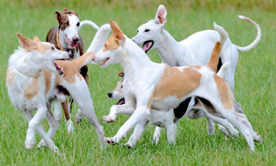
“gamboling, capering and cavorting” (commonly referred to as “the zoomies” in dogs[16]). If in the presence of similar age conspecifics, those observers might be induced by the dynamics to join in the gamboling actions (commonly witnessed with foals, lambs and calves in a farm paddock).
Provided with this categorization, one cannot readily conclude that all play is “purposeless” or “without function”[17], as it is easy to see the linkages of the play generalizations described to canine play behaviors and outcomes. Moreover, play appears to not only tap into the neural networks common to functional behaviors, but it is reasonable to infer that playful interactions deliver pleasure through the same neural systems (neurotransmitters) as other pleasurable activities[18]. There is evidence to show that dopamine[19], norepinephrine[20] and serotonin[21] are each involved in the activation or outcomes of play. An important observation, which applies to animal husbandry – in particular rearing the young and interacting with juveniles – is that long term juvenile isolation without interactions and therefore opportunities for natural expressions of activities, such as play, leads to a reduction in the potential to respond to the neurotransmitter dopamine[22]. Further, Pellis and Pellis[23] observed that there was a distinction in neurotransmitter reactions between commanding a dog to play and allowing for spontaneity in play through grabbing, tussling and petting in an engaging manner – so “play spontaneity” is an important ingredient in producing stress reducing effects and inducing that “fun element”. Part of the challenge is identifying the linkages between the two, orchestrated play (with guardian/trainer guidance) and spontaneous play (singular or with conspecifics). This is examined below.
Cost-benefit of play
Although difficult to measure with any precision, or indeed in an entirely appropriate frame of reference, there is clearly a cost of play in terms of energy expended (and hence the burning of nourishment resources) and the potential for injury during more energetic play episodes (muscle strains, falls, etc.). For animals in the wild, there is a further risk element of attracting and being unaware of the risks of predation danger through inattention. Obviously, this latter is not generally relevant to domesticated animals.
Offsetting these issues are the benefits of play, which, although widely debated in the academic literature (the debate mostly focused on the falsehood of looking for the function of play behavior) center around physical training and skills development. There is, in addition, some acknowledgement of corollary consequences of play, such as developing cognitive skills, building/bonding social relationships and the often-argued defense/ aggression training, commonly coupled with predation/predation-avoidance skills development, practiced in play fighting[24].
Canine play relevance
Notwithstanding all of this research and, perhaps surprisingly, given the easy access to the canine species outside of the laboratory, relatively little has been researched and recorded on canine play[25]. The focus has been weighted towards species “in the wild” (and in laboratory trials) – from rats, to ravens, monkeys, seals, mongooses and even turtles[26]. Conversely, there have been numerous studies centered on domestic cat behavior (as well as wild cats from Africa, Europe and North America) but only a few, relatively inaccessible, canine studies[26]. However, Mitchell[28] emphasizes the role of canine play through carefully planned and structured games according to the outcome, learning or behavior state desired. Mitchell defines “concepts” as relating to elements of personality, in that a dog - just like a human - might be optimistic/pessimistic; flexible/rigid in learning; tolerant/intolerant of frustration; calmness/excitable. Paraphrasing Mitchell’s thoughts, “concepts can be molded by games – and therefore impact personality and hence behavior – because personality is fluid and open to development”. The Mitchell thesis is about games teaching the dog how to make the choice when faced with any challenge, essentially by guiding and developing the dog’s personality alongside developing its skills – or emotional thinking – to guide it to the most appropriate choice.
Considering all of those points and putting aside, at least for now, the seemingly impossible, or at least conjectural, task of appreciating play from any particular animal’s viewpoint (their Umwelt) one might readily describe canine play from the point of view of the “average canine guardian” or even the “casual observer”, as dynamic, generally energetic, commonly with object and/or conspecific involvement, non-agonistic and not obviously functional or purposeful in the moment, but easily interpreted as a positive influence in building muscle, flexibility and reaction times, self-awareness/confidence and, given the neurotransmitter involvement, that play is a “fun and self-rewarding” activity[29].
To return to the questions originally raised regarding play as enrichment in a canine’s life, as a motivator or reinforcement reward for learning and performance and the possible drawbacks of utilizing play in these ways, consider the following.
Harnessing play as enrichment and developing physical and mental skills
The challenge of linking guardian/trainer orchestrated play to harnessing the capability growth, stress reduction and fun elements, is critical to the whole question of enrichment, motivation and reward through play activities. The three types of spontaneous play identified – Object, Social and Locomotor-rotational – whatever else these might provide or deliver, all appear to be fulfilling, invigorating and enjoyable in the canine life. These descriptors provide the very definition of enrichment activities which stimulate, benefit and develop skills and cerebral processes. Hence designing or capturing play activities can readily be seen to provide canine enrichment aligning with and enhancing natural drives and senses and developing or amplifying all of the physical, social, cerebral and decision-making skills.
In terms of enrichment activity alignment with canine natural drives, the most obvious is the parallel between object play and prey drive, but one can also see the herding instinct exemplified in certain social as well as locomotor-rotational exercise[30].
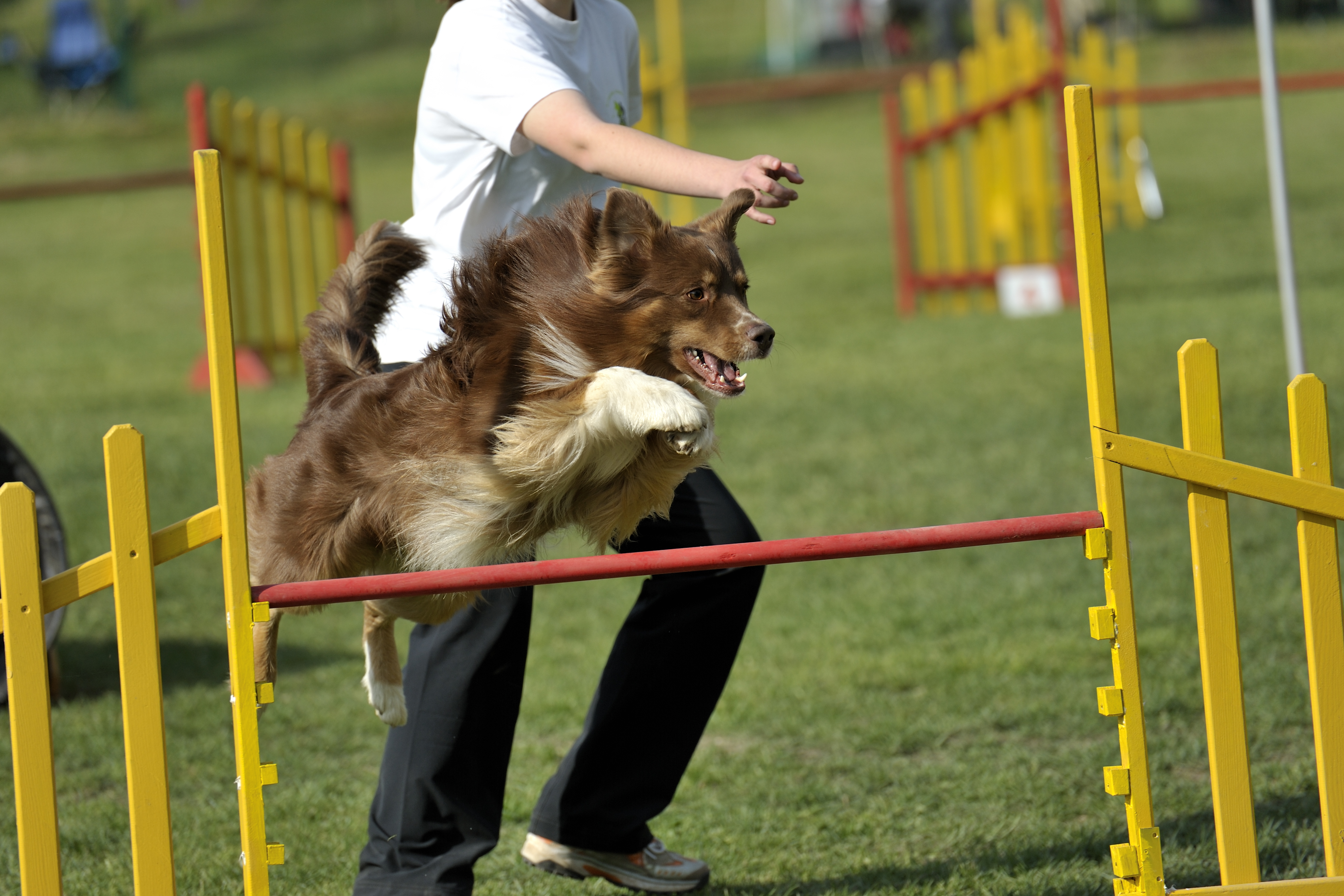
As to the question of the types of activities to stimulate canine skills, this framework of play for enrichment readily brings to mind both simple, spontaneous play between friendly canines or between guardian and dog, and also orchestrating more complex activities, such as Obedience, Agility, Scent Discrimination, Tracking (seeking/finding/ retrieving), Carting, Water Rescue and the many offshoots (Hoops, Fly-ball, Rally-O, Sprint Dog, Tricks and Dancing With Dogs, etc.). All of these enrichment activities can be undertaken at a formal competition level or simply practiced in the home or back yard as a fun engagement activity. Always a part of these organized activities is the requirements that a dog is physically capable (considering especially breed, conformation, health and age) and demonstrates enthusiasm and enjoyment when engaged in the activity (readily detected by observing canine body language).
For working dogs which have “real jobs” beyond being family pets (arguably a job in itself) – such as farm stock herding or guarding dogs, or protection dogs (military/police/bite-sports) the role of enrichment is generally filled by the requirements of their training and daily activities.
The concept of canine life enrichment covers both physical and mental exercise, showing benefits of growth and adaptability in both arenas. The “mental growth” element has further been described as enhancing decision making as well as capability in dealing with unexpected situations[31].
Harnessing play for motivation and positive reinforcement
Canine play as a tool in training might be considered in two broad categories:
1. Play as positive reinforcement or reward (after the fact) for performance of (or to encourage a repeat of) a desired action or behavior.
2. Play as an intertwined motivation and mood/scene setting stimulus to learn and perform a desired action or behavior (effectively an uplifting of mood associated with training).
Note that a guardian needs to utilise play at an appropriate level, considering timing (when and duration) and intensity, according to the aim of the play and the physical attributes of both the canine and the human.
Positive Reinforcement/Reward Play
Many canine trainers do use play as a reward for following a cue or performing a desired behavior. Most in evidence are the police, military, customs/drug and bite sports dog trainers, who commonly use “tug play” or “ball play” as the reward, instead of the reward most often seen in pet dog obedience training with the use of food treats.
Motivation Play
Motivation is a very broad term covering canine basic drives and needs as well as cognitive behavior. Burghardt[32] notes that animals often repeat play opportunities and links this to learning tasks to amplify the experience – for example by gaining a play partner. Further, play patterns repeated in different environments/circumstances might be conducive to learning or improving complex skills and negotiating complex habits[33] and the reinforcing emotions of play may facilitate training to deal with more serious events in the future[34] – which might be translated as task learning being influenced by arousal level[35] (further discussed below).
Does the reinforcement or motivational mechanism matter?
At the simplest level the answer to this question is “No – not really”, as long as the dog appears to enjoy the reward and its action/behavior is reinforced, or it is motivated to an appropriate degree[36]. However, at a more complex level, there are a number of variations, subtleties and impacts to consider. Understanding these latter issues firstly requires an appreciation of the canine breed, age and temperament (or “personality/color” as Silverman[37] refers to), the stage and challenge of the training target, development of the reward sequence (constant to intermittent) and the changing environment in which the training is taking place (i.e., level of distractions balanced by training stage).
There are two additional considerations:
1. The Law of Relative Effect
2. The Anticipation of Reward
1. The Law of Relative Effect[38] requires that we take into account that the effect of a reinforcer (or motivator) will be relative to the effects of other available reinforcers (anticipated or past experience) on a given schedule. As inferred in the reference to “changing environment of training” above, this applies to competing distractions as much as to reward reinforcement efficacy.
2) The Anticipation of Reward is not a simple subject, principally because of understanding “purposive behavior” and the idea that the future outcome (the reward) is brought into the present mind to stimulate the action or behavior.
a) The Behaviorist Model of animal psychology would have it that this can be understood to be simply a reflection that the dog responds or behaves in a certain way following a given cue or stimulus based on past experiences, the history of reinforcement.
b) Conversely, the Cognitive Model of animal psychology suggests that the animal actually expects, wants or hopes for an envisaged/imagined future outcome, which suggests a forward-looking state of mind and decision making normally only attributed to the higher cerebral dynamic of humans[39]. The concept of this awareness in the lesser animal species has been extensively covered by Griffin[40], who distinguished between “conscious awareness” and “responsiveness”. Griffin concluded that these two elements merge with progressive learning and entrenchment of ability or expertise in a given task and, further, that conscious awareness is not limited to the human species in dealing with dynamic mental images of past as well as future events.
c) Helpful in understanding the issues relating to “anticipation” in the reward context, may be to consider a simple model of a dog receiving a reward for performing a requested action or behavior in the following steps:
1) The dog becomes aware that a reward is available (in the offing).
2) The dog comes to understand how to trigger the reward (what action/ behavior activates access).
3) The dog triggers delivery of the reward by performing that certain action.
Of course, these steps may be separable or they might occur in a millisecond, especially once rehearsed/practiced and then may not be obvious to the trainer, but this does offer an explanation as to the cognitive process a dog experiences in learning a new action requiring a number of steps (always bearing in mind that this is simply a model to enlighten a sequence of canine thoughts and actions - and one might even present this model with a Behaviorist bias explanation). A good example of these three steps is offered by the technique of dumbbell retrieve training expounded in the companion article on this website Teaching the Dumbbell Retrieve.
Critical in the understanding of motivation play stimulation is that the above referenced studies show that although performance increases with physiological or mental arousal, this is only up to a point – plotted as a bell curve - with learning performance linked to arousal building and then fading (refer Yerkes-Dodson Law: Reference 35). That is, when levels of arousal become too high, this may detract from concentration and hence performance decreases. The suggestion might be made that using play as motivation or reward tools can be overdone and in fact disrupt focus on the desired task, even closing the learning window. The more difficult the task the lower should be the arousal, so the animal can focus and concentrate. This observation might link to the fact that “play may be addictive” based on the associated release of dopamine, just as gambling or drug abuse is in human subjects[41].
Not uncommon is witnessing a dog which appears to be totally obsessed with chasing a ball, fixated on this stimulant, exhibiting irrational behavior and unable to focus on any other cue or activity. One can also come to appreciate this effect by watching dogs training purely with a play reward - where it becomes evident that the reward dominates the dogs thinking with their focus being on the ball or tug, but not on the trainer/guardian - rather than the desired training objective and independent thinking. This is not to say that play reward training is wrong, but simply that understanding and moderation are required to achieve optimal outcomes[42].
2. Cancelling intrinsic reward
One type of reward not commonly described in canine training – although well known in human motivation[43] – is that of intrinsic reinforcement/reward. This is simply the satisfaction

(fun/reward) that the action itself provides. No external or following reinforcement is required or looked for. This is easily detected in many canine training scenarios, from military/police/bite sport exercises in which the dog is clearly excited and motivated by the action itself, through to obedience retrieve and scent discrimination exercises, where the reward is the successful completion of the exercise[44].
The issue here is that an applied external reinforcement/reward after the action can actually weaken intrinsic motivation. With continued after-the-action applied rewards, the animal looks for a reward other than, what in human terms, might be referred to as “self-actualization” – the excitement and satisfaction of the action alone - and learns that successful performance/ completion is not sufficiently satisfying or rewarding, but that something else should be expected. This was also referenced in the companion article on this website - The Operant Conditioning Model Fallacy, quoting Kohn [45] as evidence which challenges the Skinnerian Behaviourist view, in particular that reinforcement alone is not the answer, as it may act to lessen the core interest in learning itself and even undermine the animals “wellbeing”.
A further issue is that, having signaled the challenge of the Cognitive Model versus the Behaviourist Model, it is no great stretch to understand that a purely reward based training system might encourage the rote performance of action, as opposed to thoughtful decision making involving the discovery of principles, rules and concepts[46].
Conclusion
Linking guardian/trainer orchestrated play to canine capability growth, stress reduction and fun elements, is critical to the whole question of enrichment, motivation and reward through play activities, especially if organized play can parallel spontaneous play and/or canine drives and senses.. The three types of spontaneous play identified – Object, Social and Locomotor-rotational – whatever else these might provide or deliver, all appear to be fulfilling, invigorating and enjoyable in the canine life. Dog trainers need to determine what is the most motivating or reinforcing for their dog in the particular situation. The motivation or reward offered will compete with alternate rewards available to the dog in any situation and so the same “prize” may not always be the optimal reinforcement across the board in every environment or situation. Competing motivators/rewards are typically the opportunity to play with a conspecific, to greet a visitor, or the chase of a fast-moving prey.
Then, for the chosen reward type, the trainer needs to manage the reward choice and delivery so as to avoid “over-motivation” or “over-excitement” of the dog during a training session, varying reward type, intensity and reinforcement schedule. Particularly common is over-excitement when using play rewards (ball/tug) which can eventually lead to a loss of canine concentration and apparent ability to think through an exercise. That is, if play is the preferred reinforcement, then, just as with food treat rewards, the schedule (intermittent vs constant and sometimes rewarding with verbal praise and patting), duration (short versus extended play) and value level/intensity (may be alternating a tug game with a simple retrieve of the tug, or a ball retrieve) needs to be taken into account. This is where handler/trainer observation and discernment are required. If the dog appears over-excited by the play reward and focused only on that anticipated play, then consider making the play periods less frequent and/or less intense. Equally, if the dog is obviously so enjoying and understanding the requirements of the task or exercise, then consider avoiding a post-action reward altogether, at least beyond congratulatory applause, a pat or “good dog” appreciation of success, because adding a reward (play or food) to this latter can actually devalue the performance and satisfaction the canine experiences in performing the action/behavior itself.
In summary, the guardian/trainer needs to consider the Law of Relative Effect and
the Anticipation of Reward (which can both explain canine thought-reaction processes or interference) as well as the issue and impact of intrinsic reinforcement/reward.
So – Yes – canine play is extremely relevant and important, both in providing an enriched and balanced

canine environment and as motivation and reward – but will work more effectively if analyzed and understood in observing the reaction and impact for each individual dog, using the guidelines - and warnings against overuse - described.
References
[1] Fagen, R. (1981) Animal Play Behavior; Oxford Univ. Press; 684pp; at p.5+.
[2] Bekoff, M and Byers, J. A. (1998/reprint 1999) Animal Play: Evolutionary, Comparative and Ecological Perspectives; Cambridge Univ. Press; 274pp.
[3] Burghardt, G. M. (2006) The Genesis of Animal Play: Testing the Limits; MIT Press; 501pp.
[4] Pellis, S. and Pellis, V. (2009/reprint 2017) The Playful Brain: Venturing to the Limits of Neuroscience; Oneworld Publications; 258pp
[5] Coppinger, R. and Feinstein, M (2015) How Dogs Work; University of Chicago Press; 243pp; Ch.9 provides a good summary description of play and the challenges of definition and nature of play (pp.159-183).
[6] This is the question of release of innate instructive reactions which are not necessarily transferable across species, as noted in the companion article on this website - Canine learning interference. A dog trainer’s perspective - repeated here for convenience: Lorenz (1937) Konrad Lorenz (1937) The Companion in the Bird’s World: The Auk, Volume 54, Issue 3, 1 July 1937, Pages 245–273, https://doi.org/10.2307/4078077: introduced the concept of a "releaser," a stimulus that serves to "unlock" or release innate instinctive reactions in animals, deciding that behavior is a taxonomic character and therefore a diagnostic trait of a particular species, not synchronous nor transferrable across species. An overlay – or perhaps, refinement - on this insight was made by Pellis and Pellis (op.cit.) in their conclusion that lumping observed behaviors into a single category may seem to be useful, but runs the risk of “pigeonholing behaviors that only really make sense when species are compared within a clade of related species”. [entire Ch 6; but especially p.110]. Tinbergen, N (1963) On aims and methods of ethology; Zeitschrift fur Tierpsychologie 20; pp 410-433. A possibly more accessible account of this work (English language) is summarised by Miklosi, A (2015) Dog Behaviour, Evolution and Cognition; Oxford University Press; Ch 2 ;pp 16 – 38, also acknowledged gene related “taxonomic characteristics”.
[7] Fagen (op.cit.) [at p.42 and Chapter 2 in particular] describes all of the possible ways play might be described or categorized.
[8] Fagen (op.cit.) discusses this approach throughout his treatise, from his Preface (p.vii), Introduction and Synopsis (e.g., p.15), in Chapters 4 and 5 (pp.248-58) to concluding remarks in his Epilogue (p.495). Coppinger and Feinstein (op.cit.) refer to this trend as “the new wave of cognitive ethologists” referring to motor patterns as “intrinsic traits …. that are adaptive consequences of evolution” (p194). Burghardt (op.cit.) refers to “the naturalistic study of behavior from an evolutionary perspective” at p.10.
[9] Burghardt (op.cit.) discusses this issue of immediacy versus delayed benefits of play at pp.115-116.
[10] Straeubig, M, et al. (2016) (How) Does play matter? A transdisciplinary Approach to Play and its Relation to Neurobiology, Creativity and Deception; [January 2016 Conference: Off the Lip Conference - Transdisciplinary Approaches to Cognitive Innovation At: Plymouth]; https://www.researchgate.net/publication/295290522_How_Does_Play_Matter_A_Transdisciplinary_Approach_to_Play_and_its_Relation_to_Neurobiology_Creativity_and_Deception; Pellis and Pellis (op.cit.) at Ch.5: Pellis, et al. (2014) How Play makes for a More Adaptable Brain: A comparative and Neural Perspective; Am. J. Play; Rochester; V.7, Iss.1, pp. 73-98.
[11] Martin, P. and Caro, T. M. (1985) On the Functions of Play and its Role in Behavioural Development; Advances in the Study of Behavior; V.15; pp 59+; https://www.sciencedirect.com/science/chapter/bookseries/abs/pii/S0065345408604878
[12] Bekoff and Byers (op.cit.) pp.184-185 and pp. 188-192.
[13] Bekoff and Byers (op.cit.) describe this and other play behaviours (esp. Ch.2) and animal object play; esp. Ch.3.
[14] The Landseer Newfoundland is 8 years old; the Scottish Terrier is 18 months old.
[15] Fagen, R. (op.cit.).
[16] Technical term is “Frenetic Rapid Activity Period” – hence sometimes (rarely) referred to as “frapping”.
[17] Bekoff, M. (1984) Social play behavior; BioScience, 34; pp.228-233; “play is not purposeless, it just appears to be purposeless” (p.99).
[18] Siviy, S. M. (1998) Neurobiological substrates of play behavior: glimpses into the structure and function of mammalian playfulness; pp.221-242; and Bekoff and Byers (op.cit.) pp.224-235.
[19] Dopamine is a neurotransmitter known as the “feel good” hormone – impacting motivation, movement, memory attention and general (positive) mood.
[20] Also called noradrenaline, plays a role in the regulation of arousal, attention, stress reactions and cognitive function, i.e., supplementing alertness and energy, even leading to feelings of euphoria.
[21] Serotonin is similar to dopamine and creates long-lasting feelings of happiness and well-being as well as improved stress management. Pellis, S. and Pellis, V. (op.cit.); note at p.13 an immediate effect of playfighting in rats can be calming and can regulate stress response.
[22] Pellis and Pellis (op.cit.) at p.76 from studies of rats.
[23] Pellis and Pellis (op.cit.) at p.101 - referencing a study by Adam Miklosi and colleagues on Hungarian Police and Border Guard German Shepherds.
[24] Pellis and Pellis (op.cit.) in studying rats found that play fighting does not exactly mimic fighting with serious intent, the “end-game” being more akin to mimicking adult sexual behaviors (at pp36-37) and, importantly, that play fighting involves an element of cooperation and fairness (at p42 and p.155). Also, Bekoff and Byers (op.cit.) pp.164-167.
[25] Although Bekoff and Byers (op.cit.) do reference the apparent understanding or knowledge (cognition) of how another canine feels when it performs a “play bow” as an invitation or inducement to play (p.111 and pp.122-136).
[26] Refer esp. Burghardt, G. M. The evolutionary origins of play revisited: lessons from turtles; pp1-26 in Bekoff and Byers (op.cit.).
[27] For example, Sen Gupta, A. (1988) The structure and development of play in ferrets and dogs; Ph.D. thesis, senate House Library, University College London [quoted by Bekoff and Byers (op.cit.)].
[28] Mitchell, T (2017) How to be a Concept Trainer – Shaping your dog’s personality through games; First Stone Publ. UK; 204pp.
[29] Straeubig, M, et al. (op.cit.).
[30] Further discussion of aligning training with canine drive and instincts is covered in the companion article on this website Canine learning interference. A dog trainer’s perspective.
[31] Straeubig, M, et al. (op.cit.) and Pellis and Pellis (op.cit.).
[32] Burghardt (op.cit.) at pp.133-138 (s.5.4.1) on motivation and pp.138-143 describes the roles and influences of emotion (s.5.4.2) and external stimulation (s.5.4.) in play.
[33] Burghardt (op.cit.) p.133 paraphrased
[34] Burghardt (op.cit.) p.139 (paraphrased) and Mitchell, T (op.cit) explores the use of games in motivational arousal versus calming especially with a view to enabling/encouraging canine thinking or understanding of training concepts.
[35] This is the Yerkes-Dodson law - an empirical relationship between arousal and performance by R. M. Yerkes and J. D. Dodson (1908) referenced by Mook, D. G. (1996) Motivation; 2nd ed. W. W. Norton, NY; 352pp.
[36] Interesting to note that canine reinforcement rewards are commonly referred to as satisfying a primary need – begs the question as to whether play falls in this category? A complex summary of how primary needs have been defined can be found at https://www.bfi.co.id/en/blog/kebutuhan-primer-dan-kebutuhan-lainnya#
[37] Silverman, J, (2009) What Color Is Your Dog? Train Your Dog Based on His Personality "Color"; Lumina Media; 160pp. (2015) More What Color is your Dog? Doce Blant Publ.; 194pp.
[38] Mook, D. G. (1996; original 1987) Motivation: The Organization of Action; Norton & Co, NY/London; 2nd Ed.; 636pp; especially Ch. 9.
[39] Mook (op.cit.) Ch.10.
[40] Griffin, D, R, (1976) The Question of Animal Awareness - Evolutionary Continuity of Mental Experience; 2nd ed. (revised/enlarged) 1981; New York: Rockefeller University Press; 209pp.
[41] Burghardt (op.cit.) at pp.391-393 (s.15.3.3)
[42] Mitchell, T (op. cit.) discusses this particularly in Ch’s. 9, 10 and 11.
[43] Mook (op.cit.) pp. 305-316.
[44] A dog’s body language shows they are clearly “having fun and pleased with themselves” – and if you observe dog’s reacting in this way it will be clear this is not simply anthropomorphism – the anthropomorphic part would be to think that the dog is excited at its success because it believes it can achieve something that its human companion cannot.
[45] Kohn, A. (1993/2018 – 25th Anniversary Ed.) Punished by Rewards: The Trouble with Gold Stars, Incentive Plans, A's, Praise, and Other Bribes; Harper-Collins; 480pp. However, as possible counters to this line of argument in the canine framework, are two challenges: (a) The argument is wrapped in the extremes of constant rewards (in the dog world that would be feeding treats non-stop for every iteration of desired behavior – see comment above on intervals of reinforcement) and (b) Kohn’s studies and thesis all relate to humans (ranging from children to workers) and proffers advice to parents, teachers and people managers – not dog trainers. Does that make it all irrelevant? Perhaps not – but caution should be exercised in that automatic assumption that canine brains, temperament and emotions are all identical to those of humans, which (most of us like to think) have a different (more complex/higher) plane of cerebral dynamic operating.
[46] Mook (op.cit.) pp. 323-326.